
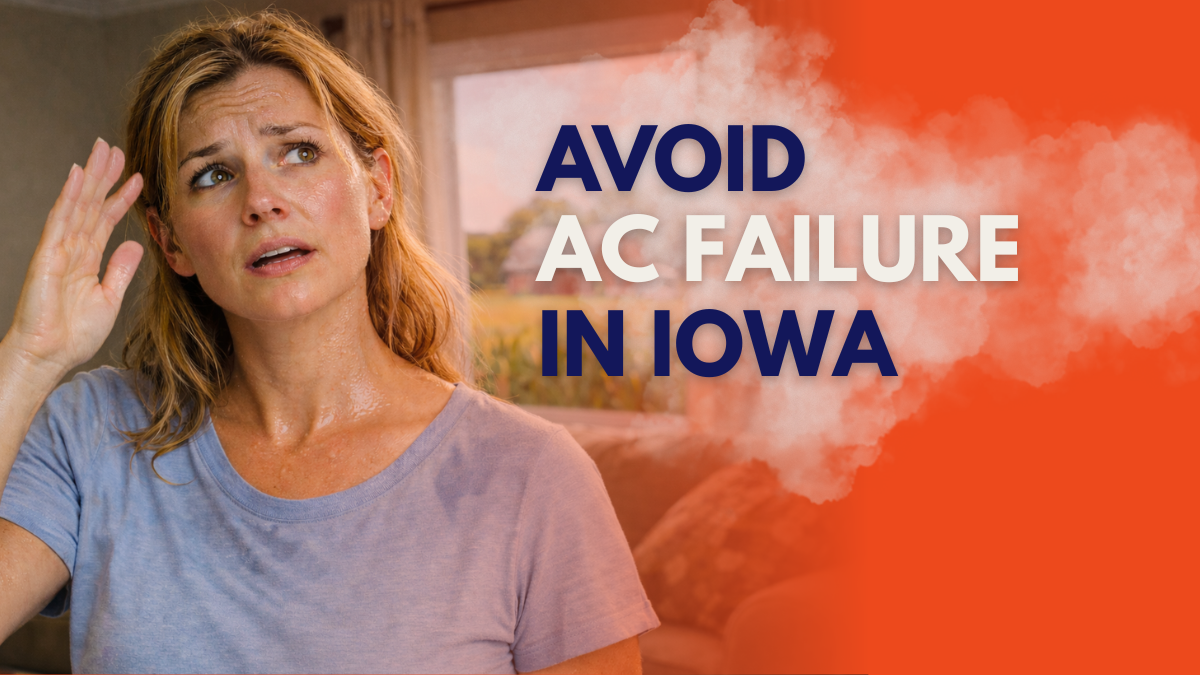
The first hot day hits in Iowa…
You turn on your AC…
And instead of cool air?
You get:
Warm air
Weird noises
Or nothing at all
Here’s the truth most homeowners don’t realize:
Your AC rarely “suddenly” fails.
It usually gives warning signs weeks (or months) ahead of time.
The problem?
Most people don’t know what to look for.
Let’s fix that.

Why AC Systems Fail Right Before Summer
In Central Iowa, your AC sits idle all winter.
Then suddenly… It’s expected to work hard again.
That combination leads to:
Worn-out parts showing up fast
Dirty systems struggling to keep up
Small issues turning into big breakdowns
That’s why spring is the most important time to catch problems early.
Your AC Is Blowing Warm (or Not-So-Cold) Air
This is the most obvious red flag.
If your AC is:
Blowing warm air
Struggling to cool your home
Taking forever to reach the set temperature
Something’s off.
Common causes:
Low refrigerant
Dirty coils
Failing compressor
This is one of the biggest “don’t wait” signs. It usually gets worse—not better.
Weak Airflow From Your Vents
Turn on your AC and feel… barely anything?
That’s a problem.
Weak airflow could mean:
A clogged air filter
Duct issues
A failing blower motor
And here’s the kicker:
Even if your AC is technically “working”…
It’s working way harder than it should.
That leads to:
Higher energy bills
Faster system wear
Earlier failure
Strange Noises You Haven’t Heard Before
Your AC should be pretty boring.
A low hum. Maybe a soft airflow sound.
Not:
Banging
Grinding
Squealing
Rattling
Those noises usually mean:
Loose or broken parts
Motor issues
Internal damage
If it sounds wrong, it probably is.
4. Your Energy Bills Are Creeping Up
If your usage hasn’t changed…
But your bill has…
Your AC might be the reason.
An inefficient system will:
Run longer
Work harder
Use more energy
All while delivering worse results.
This is one of the most overlooked warning signs.
Your AC Turns On and Off Constantly
This is called short cycling.
And it’s not normal.
You’ll notice:
The AC kicks on
Shuts off quickly
Turns back on again
Over and over.
This can be caused by:
Thermostat issues
Electrical problems
An improperly sized system
And it’s a big deal because it:
Wears out components faster
Reduces efficiency
Increases your risk of a full breakdown
You Notice Weird Smells
Your AC shouldn’t smell.
If it does, pay attention.
Common smells:
Musty → possible mold in the system
Burning → electrical issues
Chemical → refrigerant leak
This is where comfort meets safety. Don’t ignore it.
Your System Is 10–15+ Years Old
Age matters.
Most AC systems last about 10–15 years
After that, breakdown risk goes up fast.
If your system is older and showing any of these signs…
It’s not a coincidence.
It may be time to repair or even consider replacement.
You’ve Had Multiple Repairs Recently
One repair? Normal.
Two or three in a short time?
That’s a pattern.
At some point, it becomes:
More expensive to keep fixing
Less reliable
More stressful
This is where a professional can help you decide: Repair or replace?
Why Catching These Signs Early Matters
Waiting until your AC fails completely means:
Emergency service calls
Higher repair costs
Days (or longer) without cooling
And in an Iowa summer…
That’s not fun.
The better move?
Fix small problems early — before they turn into big ones.
When to Call a Professional
If you’ve noticed any of these signs, it’s worth getting your system checked.
Even if it’s “still working.”
At Anthem Heating & Cooling, homeowners across Central Iowa rely on:
Fast diagnostics
Honest recommendations
Expert repairs and tune-ups
Whether it’s a quick fix or something more serious, our team is built to help you stay ahead of the heat.
Get Ahead of the Heat
If your AC is showing any of these signs, now is the time to act.
A quick check today could save you:
Money
Stress
And a hot, uncomfortable home later
Schedule your seasonal AC tune-up today and keep your system running at its best all year-round.